


When More Dwellings Don't Fix the Deal
A Site Intel Project Breakdown
Most small-scale developments start with the same assumption:
“If we can fit more dwellings, the numbers will work.”
It’s one of the most common ways to try to fix a deal that feels tight.
This is based on a feasibility we ran on a site we were actively assessing for development.
The starting point
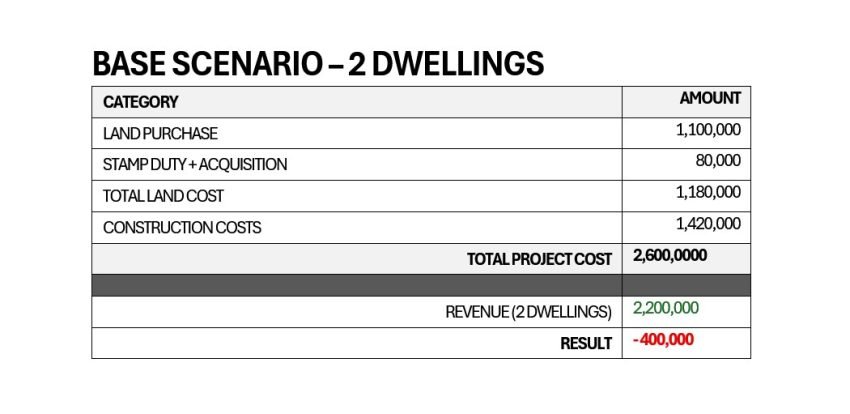
The base scenario was already under pressure.
The numbers weren’t completely broken, but they weren’t strong either. Once realistic construction costs and delivery assumptions were applied, the margin dissapeared.
Even at this stage, the issue isn’t subtle.
The deal isn’t just tight – it’s negative.
The "fix"
The typical response is to increase yield.
More dwellings should mean:
- higher revenue
- improved feasibility
- a stronger outcome
But increasing yield doesn’t happen in isolation.
It changes the project across every layer.
What changes when yield increases
Adding more dwellings meant:
- tighter layouts and reduced efficiency
- increased planning pressure
- more complex servicing and construction
- longer timeframes and higher delivery risk
The project becomes more demanding – not just larger.
The revised scenario (on paper)
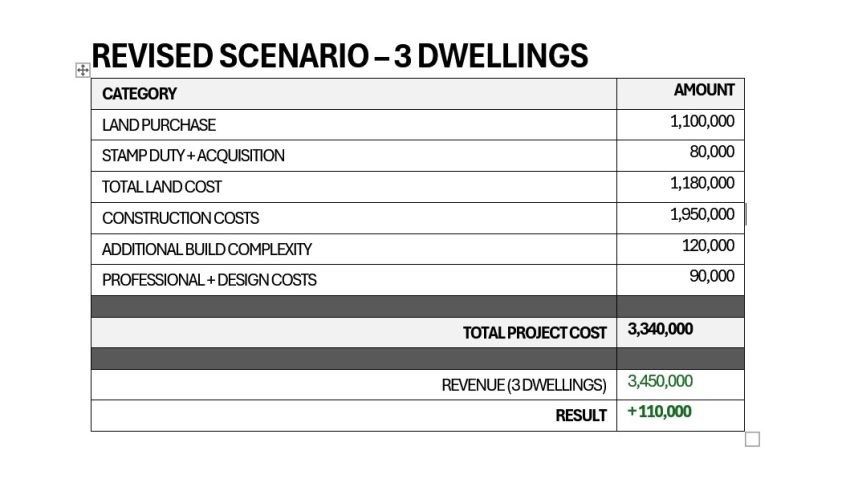
When the numbers are reworked with additional dwellings, revenue improves.
But so do:
- construction costs
- design and documentation costs
- delivery complexity
- overall exposure
At face value, the deal has moved into positive territory (just).
But the improvement is marginal relative to the increased cost and risk profile.
WHAT THE NUMBERS SUGGEST
At face value, the deal appears to improve.
Revenue increases, and the project moves into positive territory.
On paper, it looks like the additional dwellings have solved the problem.
What changes once time is included
Increasing yield doesn’t just increase construction cost.
It extends the programme.
That introduces:
- additional interest
- higher holding costs
- longer exposure to market conditions
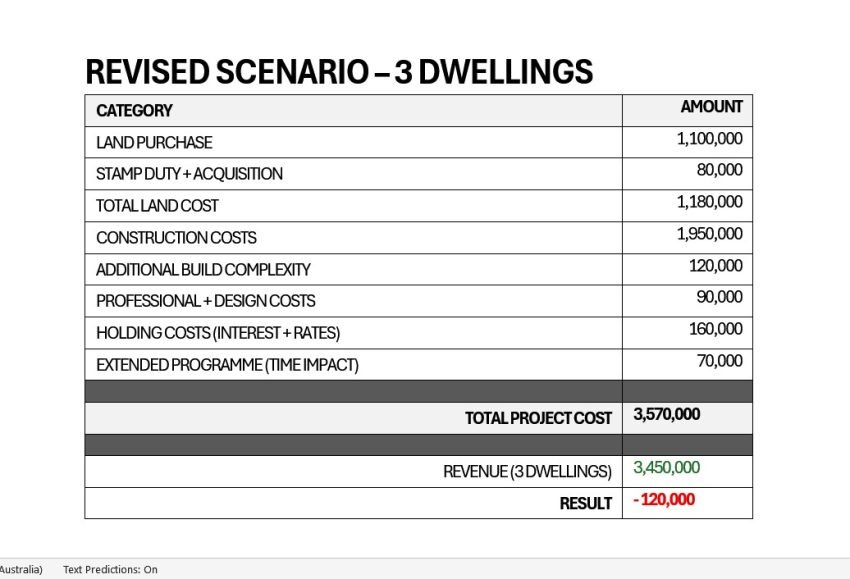
Once time and holding costs are factored in, the apparent improvement disappears.
The project quickly moves back into negative territory.
The reality check
This is where feasibility often gets misread.
The project appears to improve – until it’s tested against time, cost and delivery.
The deal moves from clearly unworkable to something that briefly looks viable, before falling back again once real-world conditions are applied.
Adding more dwellings didn’t fix the deal.
It just delayed where it broke.
What this actually shows
What was previously a negative project becomes a fragile one – highly sensitive to any movement in cost, price or time.
The underlying issue hasn’t been resolved.
The real problem
The issue isn’t yield.
It’s structure.
Specifically:
- how the land price is supported
- how construction cost aligns with the product
- how planning constraints affect what can actually be delivered
If those elements are already misaligned, increasing yield doesn’t solve the problem.
It amplifies it.
The shift that matters
The better question isn’t:
“How much can we fit on the site?”
It’s:
“What does this project need to support the land, cost and risk?”
That’s where feasibility becomes real.
The broader pattern
In many cases, pushing for higher density doesn’t improve a project.
It delays the point where it becomes obvious that it doesn’t work.
The numbers can be made to look better.
But once:
- planning constraints
- construction realities
- delivery risk
are fully accounted for, the outcome doesn’t improve in the same way.
How the project started to work
The only way this project started to move toward viability wasn’t by adjusting the design.
It was by changing the structure of the deal itself.
That meant stepping back and reassessing:
- the land position
- its cost base
- the required return
- the level of risk the project could realistically support
In this case, the shift involved looking at:
- how the land was acquired or priced
- whether the project should proceed at all in its current form
- and what configuration would actually support a viable outcome
Once those elements were addressed, the project began to move back into a position where it could work.
Not because more was added.
But because the structure was corrected.
In many cases, the right outcome isn't to push the project further. It's to restructure it - or walk away entirely.
The reality
There are plenty of sites that look like they should work.
They just don’t – once everything is aligned properly.
And that’s where most projects fall over.
Not on site.
But in the assumptions made at the start.
If the structure isn’t right early, increasing yield won’t fix it – it will just push the problem further into the project.