

"Approval" has increasingly become confused with "delivery."
But they’re not the same thing.
In this week’s Permit Pending article, I explored the widening disconnect between housing targets, planning approvals and actual project viability in today’s market.
READ THE ORIGINAL ARTICLE BELOW:
Approval Doesn't Equal Delivery by Rebecca Lloyd-Jones
The Week Housing Policy Met Market Reality
Read on SubstackThe response to that article reinforced something important:
Many projects are now failing long before construction begins – not because they can’t be approved, but because they struggle to survive the realities of feasibility, infrastructure, servicing, finance and delivery pressure.
On paper, Australia is trying to build its way out of the housing crisis.
In reality?
The market is asking a much harder question.
Can these projects actually be delivered?
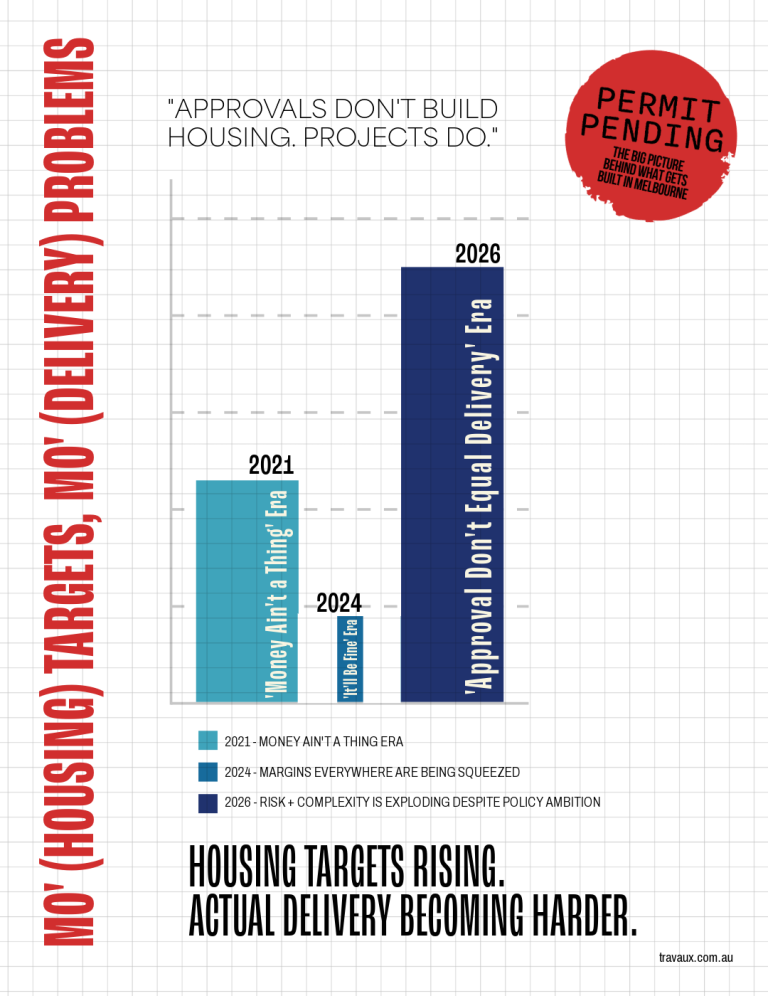
Australia doesn't just have a housing shortage. It has a delivery mismatch.
Because the exact housing typologies governments are now aggressively pushing – apartments, density, infill and higher-yield projects – are also the projects under the most financial pressure.
And this is where the market is starting to split from the planning narrative.
Because approvals, rezonings and density targets may create pipeline numbers – but projects still need to survive:
- feasibility pressure
- construction costs
- servicing complexity
- infrastructure constraints
- buyer selectivity
and - real-world delivery risk.
Approval does not automatically equal delivery.
That’s the gap the industry keeps running into.
And it’s the gap many buyers, investors and project teams underestimate early.
A permit may exist. A rezoning may be approved. A site may look promising on paper...
But that still doesn’t automatically mean:
- the project stacks up financially
- servicing is straightforward
- delivery risk is manageable
- construction complexity is viable
- infrastructure pressure is resolved
- or the end product matches real market demand
And the pressure is no longer isolated to one part of the industry.
t’s now flowing through the entire development chain:
- acquisitions
- feasibility
- finance
- construction
- buyer demand
and - project delivery itself.
Because the market is no longer responding to housing conditions emotionally.
It’s responding stucturally.
Energy is quietly becoming a development issue.
One of the less discussed stories this week was the acceleration in battery uptake and renewable infrastructure investment and at first glance, you may think this feels disconnected from housing.
It isn’t.
Energy resilience is increasingly becoming: a buyer consideration; a construction consideration and, eventually, a feasibility consideration.
And increasingly, a project viability consideration.
The developments that survive this cycle are likely to be the projects that can absorb operational pressure long after approvals are granted.
Battery rebates continue to accelerate uptake, while major players like Amazon are signing enormous renewable and storage agreements to secure long-term energy reliability for Australian operations. That matters because power pricing volatility affects operating costs; infrastructure demand affects construction inputs; and energy resilience increasingly influences buyer expectations.
"The next phase of residential development isn't just about density. It is increasingly about resilience, efficiency and operational certainty."
A rate rise now changes what sites are worth; what products are viable; and whether projects proceed at all. That is a completely different phase of the cycle.
The market isn’t collapsing. It’s splitting.
One of the more interesting signals this week was the contrast between stronger investor borrowing activity and softer broader buyer sentiment.
This is not a uniform market anymore.
The market has not stopped. It has become far less forgiving.
Melbourne is entering a more disciplined phase
Melbourne’s market still has long-term structural demand through population growth, migration, undersupply and infrastructure investment and none of that disappears overnight. But the market is clearly becoming more disciplined.
Projects that still work are generally well located, tightly designed, commercially realistic and aligned to actual buyer demand.
That sounds obvious.
But in practice, too many projects still move too quickly from:
A concept
to
consultant spend
to
acquisition pressure
Without properly stress-testing whether the project actually survives current market conditions.
That’s increasingly where strategic due diligence matters.
Not just:
“Can this be approved?”
But:
“Can this realistically be delivered?”
Where this hits your project
PLANNING
Approvals alone are no longer enough. the project still needs to stack under current market conditions.
DESIGN
Product-market fit matters more than ever. Overspecification and poor buyer targeting are becoming expensive mistakes.
CONSTRUCTION
Fuel, labour, infrastructure pressure and energy costs continue feeding uncertainty into delivery assumptions.
SALES & EXIT
Buyers still exist – but they are more selective, more constrained and slower to move.
This is the space Site Intel is designed to analyse.
Site Intel focuses on the often-overlooked gap between:
- planning theory
- market assumptions
- and construction reality
Looking beyond yield potential alone to assess:
- delivery pressure
- practical constraints
- servicing complexity
- infrastructure risk
- buyer alignment
- and broader project viability
before projects move too far down the path.
GOVERNMENTS CAN PUSH TARGETS.
COUNCILS CAN APPROVE DENSITY.
BUT EVENTUALLY EVERY PROJECT STILL RUNS INTO THE SAME QUESTION:
"does it actually work in the real market?"
And increasingly, that answer is becoming more complicated.
That’s also why strategic site analysis is becoming more important than ever.
Because approval alone doesn’t remove:
- construction pressure
- servicing complexity
- delivery risk
- funding pressure
- infrastructure constraints
or - market reality.
Site Intel was developed to help bridge that gap – translating planning ambition and development potential into clearer, more grounded project intelligence.