


Australia’s property market is increasingly behaving like several different markets at once.
This week’s signals point to a growing divide between projects that continue attracting capital and projects facing increasing delivery pressure.
Key Signals
- New-build housing continues receiving policy support
- Housing completions have fallen to a 12-year low
- Commercial property is attracting renewed investor interest
- Build-to-Rent continues gaining momentum
- Modular construction is becoming a mainstream delivery discussion
- Finance, construction costs and delivery complexity remain elevated
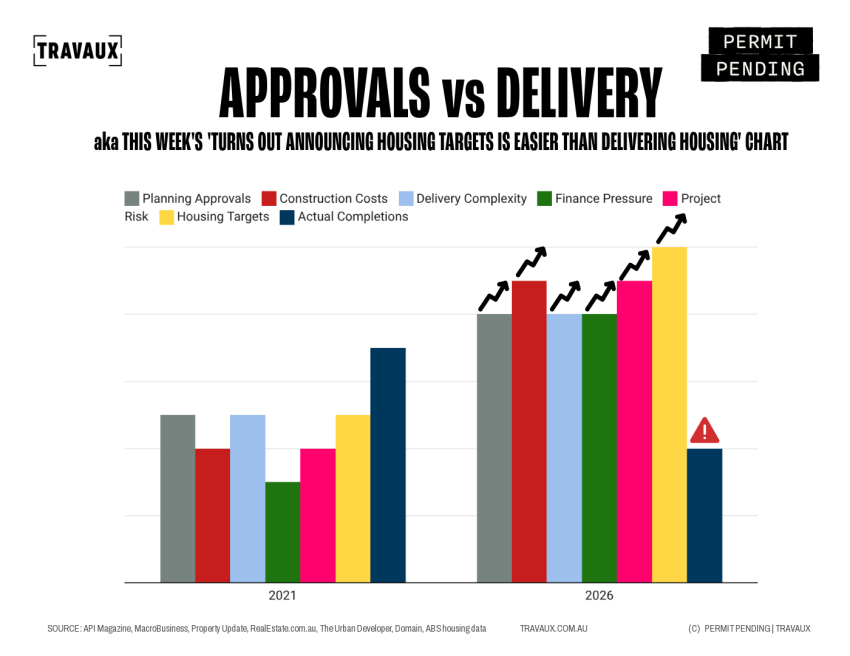
As shown in the graphic above, completions are falling regardless of government announcements.
Despite years of housing targets and planning reform discussions, Australia’s new home completions have reportedly fallen to a 12-year low.
Which highlights the core contradiction underneath the housing debate: approvals alone do not create housing delivery.
Because projects still need:
- viable finance
- realistic margins
- available trades
- infrastructure capacity
- manageable construction costs
- and buyers willing to commit.
And right now, many of those conditions remain under pressure simultaneously.
The approvals may exist however the delivery conditions often don’t.
Quick Commentary
“The approvals may exist. The delivery conditions often don’t.”
“The market didn’t stop working. The easy assumptions did.”
“Supply remains everyone’s favourite solution. Delivery remains the difficult part.”
Why It Matters
Australia’s housing challenge is increasingly shifting from approvals to delivery.
While governments continue focusing on housing targets and planning reform, many projects remain constrained by finance pressure, construction costs, labour availability and delivery risk.
The result is a growing split between housing models that continue attracting capital and projects becoming harder to justify commercially.
Read More
Read this weeks full Permit Pending analysis for a deeper look at how policy, capital and delivery pressures are reshaping Australia’s housing and development landscape.
FAQs
Housing demand alone does not guarantee delivery. Construction costs, finance conditions, labour availability and infrastructure constraints continue affecting project viability.
The housing delivery gap refers to the difference between approved housing targets and the number of homes actually being completed and delivered.
Commercial and industrial assets often offer clearer income streams, lower political intervention and more predictable operational outcomes than some residential development projects.
Build-to-Rent is attracting increasing policy support and institutional capital, creating an alternative housing delivery model to traditional build-to-sell development.
Modular and offsite construction may help reduce delivery risk, improve construction certainty and address labour and productivity challenges across the industry.
Independent perspective. Strategic clarity.
Better decisions before commitment.
Travaux provides independent strategic oversight to improve outcomes before major building and property decisions become difficult to unwind.