


Every month, new housing approval figures are released.
Politicians point to them as evidence that housing supply is increasing.
Industry groups celebrate strong approval numbers.
Media outlets report them as though they represent homes entering the market.
But there is a problem.
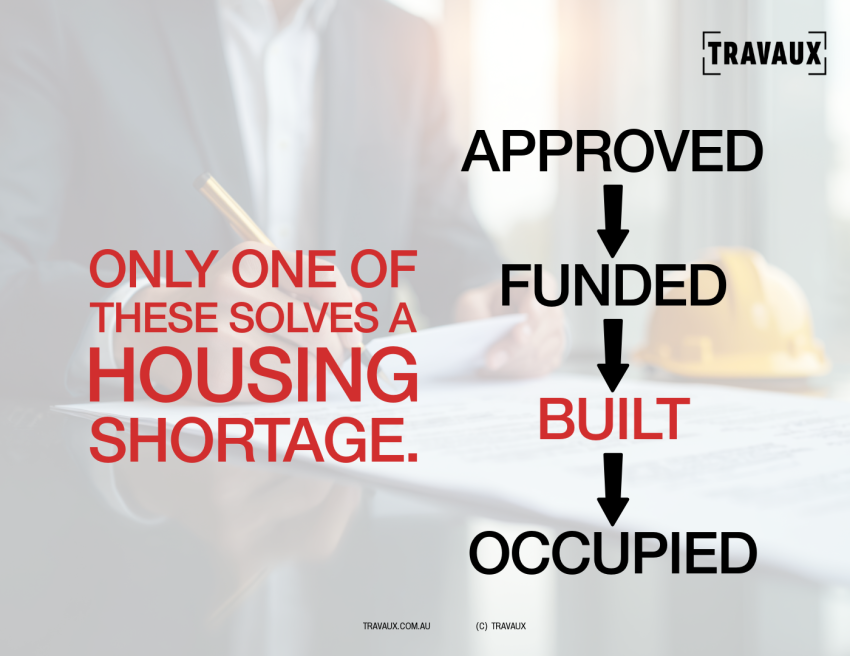
Housing approvals don’t equal housing.
An approved dwelling is not a completed dwelling.
It is not a construction commencement.
It is not a finished home.
And it is certainly not a set of keys in somebody’s hand.
Approvals are simply one milestone within a much longer housing delivery process.
The distinction matters because Australia continues to frame housing shortages as a planning problem, when the reality is often much more complicated.
A project may receive planning approval and still never proceed.
Finance may no longer stack up.
Recent policy settings can influence whether projects proceed beyond approval stage, particularly where investor confidence, taxation settings and development feasibility intersect. (Read: Federal Budget 2026-27: Construction & Development Interpretation)
Construction costs may escalate.
Rising material, labour and infrastructure costs continue to challenge project feasibility across Australia. (Read: Construction Cost Escalation in 2026)
Infrastructure requirements may change.
Interest rates may shift.
Builder capacity may disappear.
Presales may fail to materialise.
Investors may walk away.
The permit remains valid, but the housing never arrives.
This is particularly relevant when governments announce ambitious housing targets.
Targets are often measured through approvals because approvals are easy to count. They provide a visible statistic and create a sense of progress.
Delivery is much harder to measure.
Delivery requires projects to move through feasibility, finance, procurement, construction and occupation.
Every stage introduces additional risk.
Every stage creates another opportunity for a project to stall.
The housing conversation therefore risks focusing on the wrong metric.
Approvals tell us that somebody intended to build housing.
They do not tell us whether housing was actually delivered.
Imagine a manufacturing business celebrating every product order as though it had already been shipped.
Or a hospital counting appointments booked rather than patients treated.
Most industries understand the difference between intention and delivery.
Housing should be no different.
This does not mean approvals are unimportant.
Planning reform matters.
Assessment efficiency matters.
Certainty matters.
But planning is only one link in a much larger chain.
Housing delivery depends on land, infrastructure, finance, feasibility, procurement, labour, construction and market demand all working together.
Housing shortages are rarely caused by a single failure. They emerge when one or more parts of the delivery chain break down.
Weakness in any one of those areas can stop a project that has already received approval.
That is why housing debates often feel disconnected.
One group argues for planning reform.
Another argues for infrastructure investment.
Others focus on migration, construction costs, modular housing or finance.
The Housing Delivery Chain
Australia’s housing debate often treats planning, infrastructure, finance and construction as separate issues. They are not.
They are interconnected parts of a single delivery system.
A project must move through:
- Land acquisition
- Planning approval
- Infrastructure provision
- Finance
- Procurement
- Construction
- Occupation
Failure at any stage can stop delivery.
This is why approvals alone cannot solve a housing shortage.
In reality, each is discussing a different section of the same delivery system.
Housing is not a single problem.
It is a chain.
And chains are only as strong as their weakest link.
If Australia genuinely wants more housing, we need to stop asking how many homes were approved and start asking how many homes were actually delivered.
Because an approval may be the beginning of a housing project.
But it is delivery that ultimately solves a housing shortage.
Looking beyond the headlines?
Housing approvals are only one piece of the puzzle. Travaux helps developers, investors and project teams understand the risks, constraints and opportunities that influence whether a project gets delivered.
Explore our Build-Ready Reports or contact Travaux to discuss your next project.
FAQs
A planning approval allows a project to proceed, but delivery still depends on finance, construction costs, infrastructure, labour availability and market demand.
Approvals indicate permission to build. Completions represent homes that have actually been constructed and are ready for occupation.
Projects may become unviable due to rising construction costs, interest rate changes, funding issues, infrastructure requirements or market conditions.
Planning can contribute to delays, but housing delivery also depends on finance, infrastructure, procurement, labour and construction capacity.
The housing delivery chain includes land acquisition, planning approval, infrastructure provision, finance, procurement, construction and final occupation.