


Reading Time
6-7 minutes
The Headlines Tell One Story. The Data Tells Another.

Australia’s housing conversation has become increasingly contradictory.
On one hand, we’re told there aren’t enough homes. Governments continue announcing ambitious housing targets, planning reforms and supply initiatives designed to accelerate construction.
On the other, the latest economic indicators are pointing to a market becoming noticeably more cautious.
Household spending has weakened, inflation remains a concern, borrowing costs are elevated and investor confidence has softened.
Clearance rates have eased, dwelling values are flattening or declining in several capital cities, and developers continue to grapple with rising construction costs and uncertain project viability.
None of these indicators suggest housing demand has disappeared. Rather, they suggest market participants are reassessing risk before committing capital.
The market isn’t freezing. It’s becoming more selective.
Investors Haven't Left. They Are Just Changing Their Behaviour.

One of the more interesting findings from the latest API Property Sentiment Report is that confidence has declined much more sharply than purchasing intentions.
Investors are clearly more cautious about the market outlook, yet many still intend to buy over the next 12 months.
That disconnect matters.
If investors were exiting the market entirely, we would expect purchasing intentions to collapse alongside confidence. Instead, many appear to be changing how they invest rather than whether they invest.
That means:
- greater scrutiny of feasibility
- stronger focus on rental income
- closer attention to tax settings
- increased sensitivity to holding costs
- preference for lower-risk opportunities.
Rather than chasing rapid capital growth, many investors appear to be prioritising resilience.
The market isn’t losing participants. It’s demanding better projects.
Feasibility Has Become the New Constraint.

For much of the past decade, the primary challenge was finding enough development opportunities to satisfy demand.
Today, many opportunities exist on paper.
The challenge is making them stack commercially.
Developers are navigating higher interest costs, elevated construction prices, increased consultant fees, infrastructure contributions, longer approval timeframes and shifting buyer expectations.
Each factor might be manageable in isolation.
Combined, they can fundamentally alter project feasibility.
This is why planning reform alone cannot solve Australia’s housing shortage.
Removing one barrier is valuable, but projects still need to survive every stage between site acquisition and completion.
Supply is no longer constrained solely by planning.
It is constrained by commercial viability.

Housing Delivery Is Becoming More Complex.
This week’s commentary reinforces a broader trend that has been emerging for some time.
Housing is no longer simply a construction challenge.
It is a coordination challenge.
Delivering homes requires alignment between:
- planning systems
- finance
- infrastructure
- consultants
- builders
- manufacturers
- purchasers
- governments.
Weakness in any one part of that chain slows delivery.
This is why Australia can simultaneously experience:
- housing shortages
- declining commencements
- approved but stalled projects
- cautious investors
- high rents.
These are not contradictions.
They are symptoms of a delivery system under pressure.
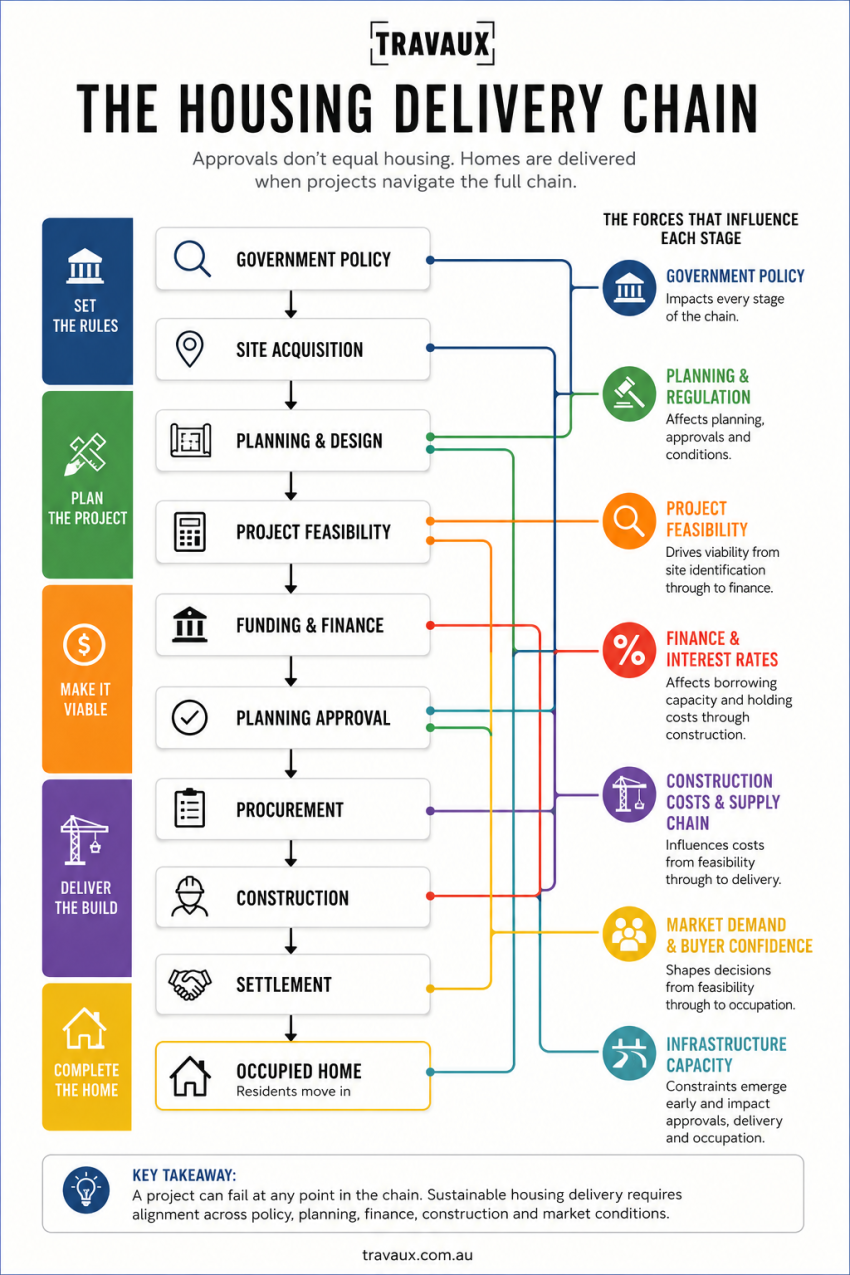
The Housing Delivery Chain™
A framework developed by Travaux.
Why Market Repricing Matters
The term “repricing” often attracts attention because people associate it with falling property values.
In reality, markets reprice risk constantly.
Today’s repricing extends well beyond residential property values.
Banks are reassessing lending.
Developers are reassessing margins.
Builders are reassessing fixed-price contracts.
Investors are reassessing expected returns.
Governments are reassessing policy settings.
Each participant is asking the same question:
Does this still make sense under today’s conditions?
When enough people ask that question simultaneously, the market behaves differently.
Projects are redesigned.
Sites remain undeveloped.
Purchases are delayed.
Capital moves elsewhere.
Markets don’t need to crash to slow housing delivery. They simply need participants to become more cautious.
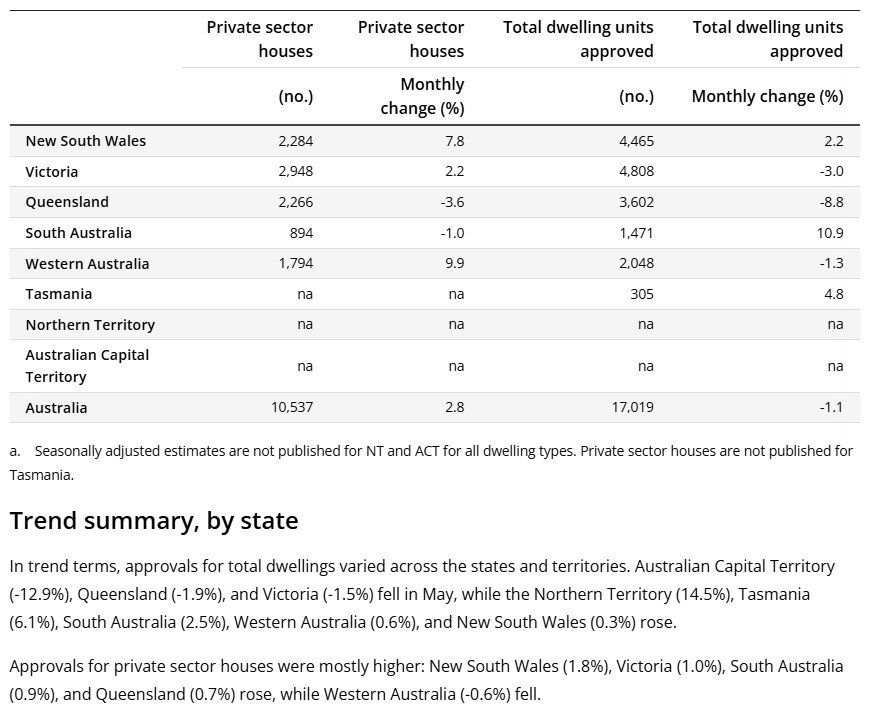
Despite policy efforts, approvals continue to fluctuate and remain only one part of housing delivery as shown in the ABS Private Residential Building Approvals data this month
- ECONOMY & CONSUMER CONFIDENCE
- PROPERTY MARKET & PRICING
- THIS WEEK'S AUCTION RESULTS
- INVESTORS & POLICY
- HOUSING DELIVERY & DEVELOPMENT

Want to understand whether a development stacks up before spending thousands on consultants?
Travaux Build-Ready Reports help developers, investors and project teams assess planning constraints, feasibility risks and delivery considerations before committing to a site.
Looking Beyond This Cycle
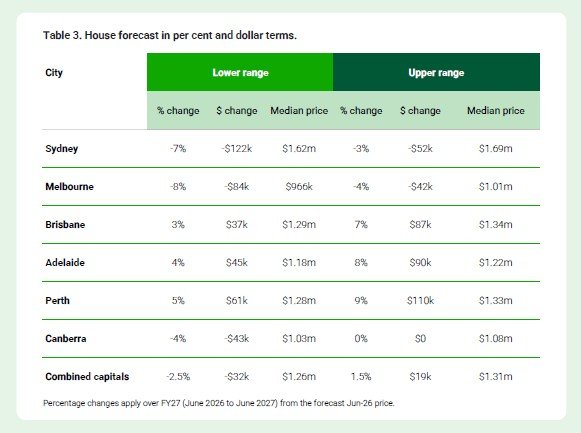
It would be easy to interpret recent data as simply another housing cycle. That may prove partly true. However, there are signs that something more structural is occurring.
Construction costs remain materially higher than pre-pandemic levels.
Planning systems continue to struggle with complexity.
Infrastructure funding remains constrained.
Productivity challenges persist across the construction sector.
Population growth continues to place pressure on housing demand.
These are not short-term fluctuations.
They represent structural pressures that will influence housing delivery well beyond the next interest rate decision.
If Australia is serious about increasing housing supply, the conversation needs to move beyond counting approvals or announcing targets.
It needs to focus on whether projects can actually progress from concept to completion.
Because homes are not created when permits are issued.
They are created when viable projects successfully navigate the entire housing delivery chain.
This Week's Sources
Supporting Data
Reserve Bank of Australia – Monetary Policy Decision (June 2026)
ABS – Building Approvals, Australia
Cotality (formerly CoreLogic) – Home Value Index
API Property Sentiment Report Q1 2026 (uploaded) – Investor confidence has softened, but purchasing intentions remain resilient, suggesting a market recalibrating rather than retreating.
FAQs
While some markets are softening, the bigger story is that buyers, developers and investors are reassessing risk due to higher interest rates, construction costs, financing conditions and policy uncertainty. This is producing a repricing rather than a broad market collapse.
It means participants are demanding stronger financial fundamentals before committing to projects or purchases. Assumptions that worked during low-interest-rate environments are no longer sufficient under today’s financing and construction conditions.
Planning approvals are only one stage of the housing delivery chain. Projects must still secure finance, remain commercially feasible, obtain builders, manage construction costs and ultimately be completed before they contribute to housing supply.
Alongside planning reform, governments need policies that improve project feasibility, reduce unnecessary delivery costs and address the practical barriers that prevent approved projects from reaching construction and completion.
The housing delivery chain includes land acquisition, planning approval, infrastructure provision, finance, procurement, construction and final occupation.