



How inflation, construction costs and market changes translate into real decisions for small developers...
When people first start learning about property development, the feasibility spreadsheet can feel abstract.
Numbers move. Margins change. Scenarios appear.
But what do those numbers actually mean on a real project?
To illustrate this, let’s use a simple example: a dual occupancy development in Mentone. Below is the summary of project costs.
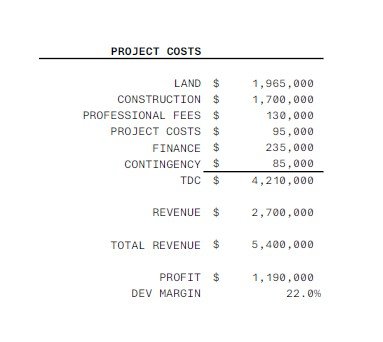
Base assumptions:
REVENUE – $5.4M
TOTAL DEVELOPMENT COST – $4.2M
MARGIN – 22%
That’s a healthy starting point. But development projects rarely operate under perfect conditions.
So we stress-tested the project to see what happens when the key variables move.
SCENARIO ONE
A 10% Drop in End Values
In this example, if sale prices fall by 10%:
Profit falls from
$1.19M → $650k
That’s a $540,000 reduction in profit.
For a new developer, this is more than just “less money”.
It affects several practical things.
1. YOUR FINANCE POSITION
Banks assess development loans partly on expected project margin.
If margins fall too far, lenders may:
• reduce loan amounts
• require more equity
• increase interest margins
• refuse to fund similar projects in the future
A developer who consistently produce tight or marginal feasibilities will find financing more difficult over time.
2. YOUR ABILITY TO MANAGE UNEXPECTED PROBLEMS
Construction projects almost always experience surprises:
• ground conditions
• service relocations
• design changes
• delays
A project that loses half its profit due to market movements has far less ability to absorb those shocks.
3. YOUR LONG-TERM DEVELOPER REPUTATION
Developers build reputations with lenders, consultants and builders.
Projects that remain profitable under pressure strengthen that reputation.
Projects that struggle financially tend to limit future opportunities.
SCENARIO TWO
Construction Costs Increase By 10%
In this case, construction costs increase by roughly $150k.
Profit falls from:
$1.19M → $1.04M
That still leaves the project viable, but something important changes.
Your margin buffer becomes tighter.
When margins tighten, developers start paying attention to small decisions that add up.
Examples on a real project might include:
• selecting the $50 door hardware set instead of the $95 version
• choosing a standard tile format rather than a custom import
• simplifying facade materials
• reducing complex roof forms
• standardising window sizes
These decisions don’t reduce the structural quality of the home, but they do change the look, feel and level of finish, with flow-on effects across the entire design.
They’re not really “savings”. They’re offsets to rising construction costs.
The challenge is that even small changes can have an outsized impact on how the project is perceived. Swapping out finishes, simplifying details or reducing specification can shift a project from a high-end architectural product to something that reads as mid-range or value-driven.
Once that shift happens, the implications go well beyond cost.
You may no longer be competing in the same part of the market you originally designed for. That can affect:
• your target buyer
• your marketing strategy
• your achievable sale price
• your overall revenue assumptions
In extreme cases, a project that began as a premium product can end up being marketed to an entirely different segment, simply because the final presentation no longer supports the original positioning.
This is where feasibility and design become tightly linked. Decisions made to manage cost don’t just protect margin, they can also reshape the product itself, and in doing so, influence the final sales outcome.
That is why experienced developers spend significant time working with architects and builders on buildability and cost control before they start making selections.

SCENARIO THREE
Construction Delays
In the sensitivity test, we assumed delays of three to six months.
That may seem conservative at first glance, but when you look at current global conditions, particularly supply chain disruptions and material delays, those timeframes become more realistic. Small delays compound quickly. A few days waiting on materials, a week lost between trades, or minor sequencing issues can escalate into meaningful programme slippage.
Delays increase finance and holding costs, and they also introduce additional market risk.
Even a relatively small delay can cost:
$35k – $70k
This occurs because developers are still paying for:
• interest on the construction loan
• site holding costs
• insurance and project overheads
Delays also introduce market risk.
If the project finishes later than expected, it may sell into a different property market.
Break-Even Sale Price
The project’s total development cost is approximately $4.21M. With two dwellings, the break-even sale price is roughly:
$2.10M per dwelling.
At this point, the project covers all costs, including construction, professional fees, finance and holding costs, but generates no developer profit.
Compared with the assumed sale price of $2.7M, the project has an approximate buffer of around $595,000 per dwelling.
On the surface, that feels comfortable.
But this is where many new developers misunderstand what break-even actually represents.
Break-even is not a target. It is a warning line.
Operating at or near break-even means:
- there is no buffer for unexpected costs
- there is no compensation for risk taken
- there is no return for the time invested – often 18-24 months
- there is limited capacity to absorb delays or further market movement.
In practical terms, if a project begins to trend toward break-even, it places pressure on every part of the development.
FINANCE
Lenders assess projects based on margin and risk. A project nearing break-even may struggle to secure funding or require additional equity to complete.
CASH FLOW AND DECISION MAKING
Without profit buffer, developers are forced into reactive decisions. This often leads to rushed cost-cutting, design compromise or delayed problem-solving.
SALES STRATEGY
If end values soften and approach break-even levels, developers may need to discount or accept lower offers simply to exit the project and recover capital.
FUTURE PIPELINE
Projects that perform poorly or deliver minimal return can limit a developer’s ability to move onto the next opportunity.
Disciplined developers don’t aim for break-even. They aim to maintain enough distance from it to ensure the project can absorb pressure and still perform.
This is why experienced developers often work backwards from a required margin, rather than forwards from a site purchase price. The margin is what protects the project. Everything else must fit within it.

Residual Land Value
Using a target developer margin of 17%, the residual land value for the site is approximately:
$2.24M.
The land purchase assumed in the example is $1.85M.
That leaves a buffer of roughly $387k between the purchase price and the maximum feasible land value.
Again, this buffer is what allows the project to absorb moderate changes in costs or timelines.
The Real Lesson for New Developers
Feasibility models rarely fail because of a single variable.
They fail when multiple pressures occur at the same time:
• construction costs increase
• timelines extend
• interest rates rise
• buyer demand softens
Disciplined developers test their projects against these scenarios early.
Speculative developers assume conditions will remain perfect.
History tends to reward the first group.