
The past week has moved quickly.
Fuel supply concerns, excise cuts and global escalation have all hit at once. The headlines are noisy, but the implications for development are actually quite straightforward:
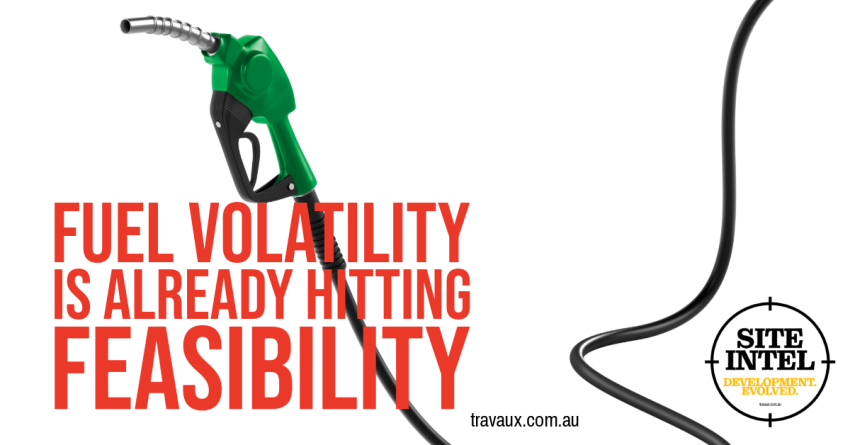
COST VOLATILITY IS BACK IN THE SYSTEM.
This is not just about petrol prices. Fuel sits underneath everything involved in construction.
Transport.
Materials.
Labour movement.
Site operations.
When it moves, everything moves.
The excise cut has provided temporary relief, but it has not addressed the underlying issue – constrained and unstable supply.
At the same time, global conditions have escalated. Energy routes remain exposed and market risk is being priced accordingly. That risk is already flowing through procurement chains and contractor pricing.
We are now seeing early signs of:
- supplier pricing tightenting
- shorter quote validity periods
- increased provisional allowances
- early movement in transport-heavy materials
This is how feasibility starts to shift.

What Actually Changes on a Project
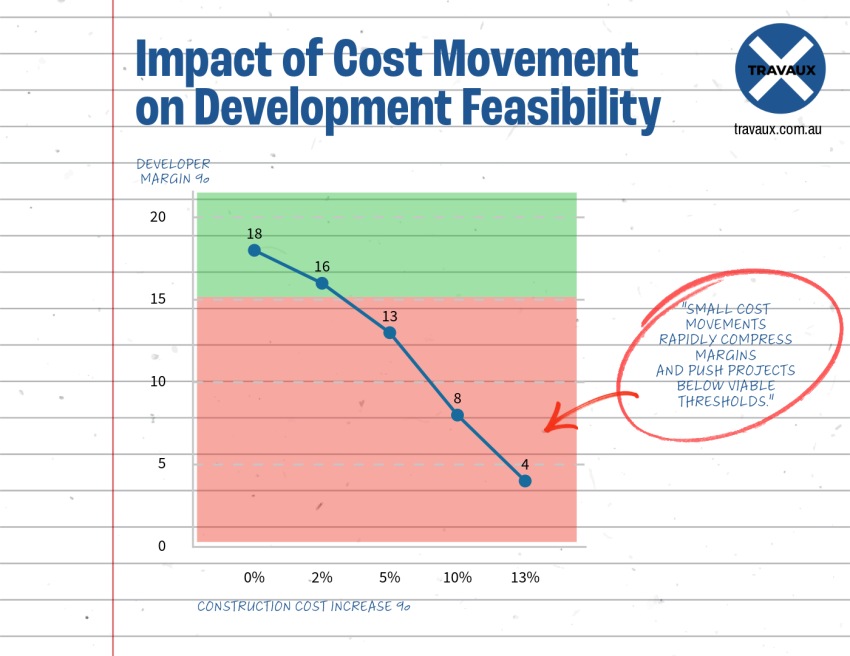
First thing you’ll notice. Small cost increases don’t stay small.
A 3-5% movement across materials and logistics can translate into:
- margin compression
- reduced specification
- redesign of key elements
- delayed procurement decisions
- or projects stalling entirely
This is particularly relevant for medium-density and design-led projects, where margins are already narrower and delivery risk is higher.
The projects most exposed right now are:
- Townhouse developments
- Boutique infill projects
- Architechturally-driven builds
- Projects relying on tight feasibility assumptions
What Holds vs What Falls Away
In volatile conditions, the market filters.
Projects that tend to hold:
- simpler construction methods
- standardised product
- conservative design and detailing
- strong contingency built in
Projects that tend to fall away:
- highly specified finishes
- complex builds with tight margins
- projects relying on optimistic cost assumptions
- developments without pricing locked early
That is not a demand problem.
It’s a deliverability filter.
My Practical Advice on What To Do Now
Right now, the priority is not reacting to headlines.
It’s adjusting project settings.
- RE-RUN FEASIBILITY with updated cost allowances
- INCREASE CONTINGENCY on transport and material-heavy trades
- REDUCE RELIANCE on assumptions
- LOCK KEY PRICING earlier where possible
- TEST SENSITIVITY at +5% and+10% cost movement
- BE CLEAR on where design can flex AND WHERE IT CANNOT
And critically:
- DO NOT CARRY OLD FEASIBILITY LOGIC into new conditions
The Shift
This is not a one-off spike.
It is a reminder that cost, risk and delivery are tightly linked – and can move quickly when global conditions change.
The projects that proceed from here will not be the most ambitious.
But, they will be the ones structured to absorb movement. Becoming a successful developer is a long-game and you need to adapt to survive.
The shift underway doesn’t mean projects stop. It means they need to be structured differently.
This is where working in isolation becomes a risk. The projects that hold up in volatile conditions are the ones supported by the right inputs – early advice, clear feasibility testing, realistic procurement strategy and the willingness to adapt the brief before it becomes a problem on site.
That may mean changing product type, simplifying delivery, staging differently or rethinking where value actually sits in the project.
What won’t hold is pushing forward with standard assumptions and hoping conditions stabilise.
If you’re assessing a project right now, the priority is to sense-check it against current conditions, not the ones it was conceived under.
Adjust early.
Test properly.
And make decisions with clarity – while you still have room to move.
Unsure How Your Project Holds Up?
If you're unsure how your project holds up under current conditions, now is the time to test it properly.
Let's discuss your feasibility, procurement approach or project strategy before decisions get locked in.
Get In Touch