


Dispatches | July 2026
The Australian housing market is sending mixed signals.
Dwelling values are slowing. Confidence has weakened. Melbourne is struggling. Yet rents remain high, population growth continues and Australia still isn’t building enough homes.
At first glance, those statements don’t seem to belong together.
But over the past week I found myself reading three very different perspectives on the market. The Australian Property Institute’s latest sentiment survey, Cameron Kusher’s market analysis and Michael Yardney’s Melbourne update all approached the market from different directions.
One measures confidence.
One measures the economy.
One focuses on long-term property investment.
Despite that, they arrive at remarkably similar conclusions.
The question is what those conclusions actually mean.
Not for house prices.
For housing delivery.
Three different lenses
The API’s Property Sentiment Report isn’t trying to predict prices. It measures how property professionals feel about the market.
That confidence has clearly softened, particularly in Victoria, where residential sentiment remains among the weakest in the country.
Cameron Kusher looks at the same market through an economist’s lens. His latest analysis points to slowing dwelling values, weaker buyer demand, higher listings and continued affordability constraints. He argues the current downturn may have further to run.
Michael Yardney comes from an investor’s perspective. His message is more measured. Yes, Melbourne is underperforming and the market has cooled, but Australia’s long-term supply constraints haven’t disappeared. Property cycles continue, and quality assets tend to recover over time.
Three different audiences.
Three different objectives.
Yet they broadly agree on where the market stands today.
Melbourne is becoming Australia's housing laboratory
For those of us working in Victoria, this is where the conversation becomes interesting.
Melbourne isn’t simply experiencing slower price growth.
It’s testing whether a city can simultaneously have:
- declining dwelling values
- persistent housing shortages
- growing population
- weak development confidence
- fewer financially viable projects.
That combination matters.
Because housing shortages aren’t solved simply because prices stop rising.
If anything, the opposite can occur.
The question nobody seems to be asking
Most commentary still revolves around one question:
Will prices keep falling?
Of course that is a very relevant question, I, however, am becoming more interested in another question…
What happens to housing delivery if prices do continue to fall?
If buyer confidence weakens…
…developers become more cautious.
If developers become more cautious…
…projects become harder to finance.
If finance becomes harder…
…fewer projects commence.
And if fewer projects commence today, the effects won’t appear immediately.
They’ll show up in construction completions one, two or even three years from now.
That’s the nature of the housing delivery chain.
The consequences arrive long after the headlines have moved on.
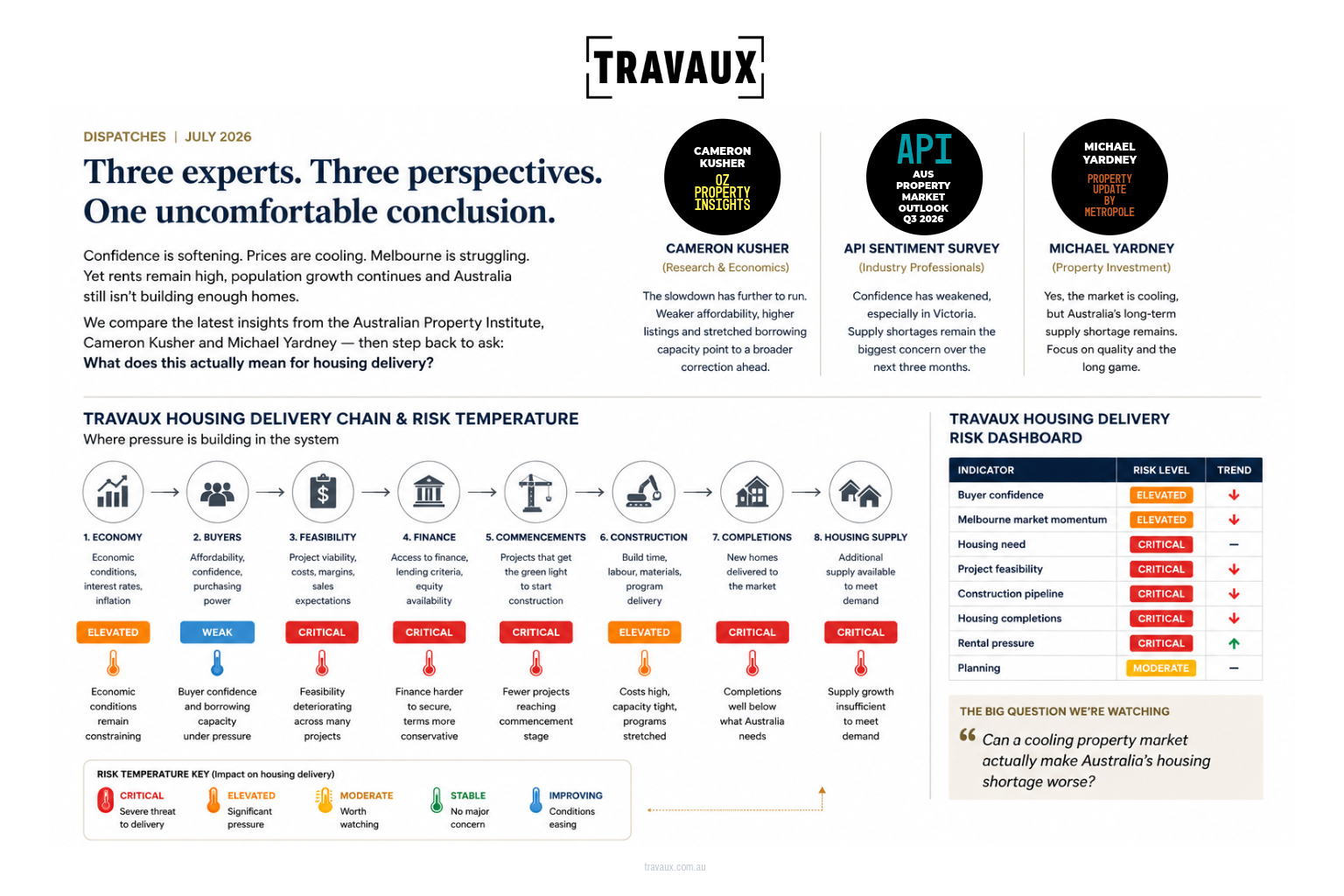
A housing shortage doesn't guarantee rising prices
This is one of the biggest misconceptions in the current debate.
Australia can simultaneously have:
- too few homes
- weakening house prices
- strong rental demand
- declining project feasibility.
These aren’t contradictions.
They’re symptoms of different parts of the housing system moving at different speeds.
Underlying housing need remains high.
Effective purchasing power has weakened.
Those are two completely different measures.
The Travaux Temperature Check
One thing immediately stands out in the chart above.
Almost every indicator is moving in a different direction.
That’s exactly why the housing market has become so difficult to interpret.
What I'm watching
Over the coming months, I’m less interested in whether Melbourne records another one or two per cent movement in dwelling values.
I’m watching whether today’s softer market quietly reduces tomorrow’s housing supply.
Because if projects become financially unviable before they begin, Australia won’t simply have a slower property market.
We’ll have an even smaller pipeline of future homes.
And that may prove to be the more important story.
Dispatches
Every month I’ll compare what economists, investors, researchers and industry professionals are seeing on the ground, then step back and ask a different question:
What does this actually mean for housing delivery?
FAQs
Melbourne’s housing market has been weaker than many other capital-city markets, with softer buyer confidence, slower sales activity and subdued price momentum. The important point is that a weaker sales market does not necessarily mean housing need has reduced.
House prices reflect what buyers can afford and borrow, not just how many people need housing. A city can have strong underlying housing need while prices weaken because borrowing capacity, confidence and affordability have deteriorated.
Yes. If softer prices and weaker buyer demand reduce project feasibility, developers may defer or abandon projects. That can lead to fewer commencements and fewer completed homes later, worsening the shortage over time.
Housing demand refers to the number of people who need somewhere to live. Effective demand refers to the number of people who can afford to buy or rent at current prices. The two can move in different directions.
A project must remain commercially viable before it can secure finance and proceed to construction. Rising costs, weaker sales expectations, tighter lending and lower valuations can all reduce feasibility, even where housing need is high.
Planning is one part of the delivery system, but it is not the only constraint. Finance, construction costs, infrastructure, labour, sales conditions, developer decisions and market confidence can all prevent approved projects from becoming completed homes.
It measures the level of pressure each part of the housing delivery chain is placing on future supply. It is not a house-price forecast and it is not a sentiment index.
The rating refers to delivery risk, not activity. A critical rating means the pipeline is under serious pressure from weaker feasibility, fewer commencements, high costs or constrained delivery capacity.
The Dispatch compares the Australian Property Institute’s industry sentiment data, Cameron Kusher’s market and economic analysis, and Michael Yardney’s property investment and Melbourne market outlook. Travaux then considers what their combined findings mean for housing delivery.
The key indicators are project commencements, finance approvals, sales rates, construction costs, listings, dwelling completions and the number of approved projects that actually proceed. These will show whether today’s market weakness is reducing tomorrow’s housing supply.