


Does Faster Planning Actually Delivery Housing Faster?
We’ve spent years trying to make planning faster.
But are we measuring the wrong outcome?
There are a few ideas in Australian housing policy that attract as much agreement as planning reform.
Planning is too slow.
Approvals take too long.
Councils are holding up housing.
Fix planning, and housing supply will improve.
It sounds logical. It may even be partly true.
But over the past few months I’ve found myself asking a different question.
Has anyone actually demonstrated that reducing planning time meaningfully reduces the total time taken to deliver a home?
Not the approval.
The home.
Because they aren’t the same thing.
The Housing Delivery Timeline
Every residential project follows a chain. A simplified version of that chain looks something like I’ve detailed in the graphic on the right.
As you can see there are many stages a residential build goes through from inception to delivering an actual home.
Planning is just one stage in a number of stages. An important stage, yes, but still just one of the many stages.
So if planning becomes six months faster, what happens next?
Does construction begin six months earlier?
Or does the project simply arrive six months earlier at another bottleneck?
The Domino Effect
Imagine planning approval is reduced from twelve months to six.
Great.
The project reaches detailed design sooner.
Except…
The structural engineer has a three-month wait.
The civil engineer is booked out.
The electricity authority requires network upgrades.
The sewer authority needs additional capacity.
Finance is reassessed because construction costs have increased.
The preferred builder is committed for another eight months.
Have we actually saved six months?
Or have we simply shifted where the project waits?
Measuring Activity Instead of Delivery
One of the things Australia does remarkably well is measure activity.
Planning applications.
Planning approvals.
Rezoning.
Housing targets.
Announcements.
Funding packages.
The media announcements go on and on and on…..
These are all useful.
But they are inputs.
Not outputs.
The output that matters is remarkably simple. A completed, occupied home. Everything else is part of the process.
A Research Gap
I’ve been looking for data that follows projects from conception all the way through to completion.
Not planning statistics.
Not commencement statistics.
Not completion statistics in isolation.
The entire chain.
How long does each stage take?
Which stages are predictable?
Which stages create the largest delays?
Where do projects stall?
Which delays are controllable?
Which are market driven?
Which projects never proceed at all?
Surprisingly little work appears to examine housing delivery this way.
Yet this is precisely where better policy decisions could be made.
What if Planning Isn't the Long Pole?
This isn’t an argument against planning reform.
Planning certainty is valuable.
Clearer rules reduce risk.
Better planning systems improve investment confidence.
None of that is in dispute.
But what if planning isn’t the longest delay anymore?
What if labour shortages, infrastructure sequencing, finance availability or construction capacity have become larger constraints?
If that’s true, then further planning reform might produce diminishing returns unless those downstream bottlenecks are addressed at the same time.
Better Questions
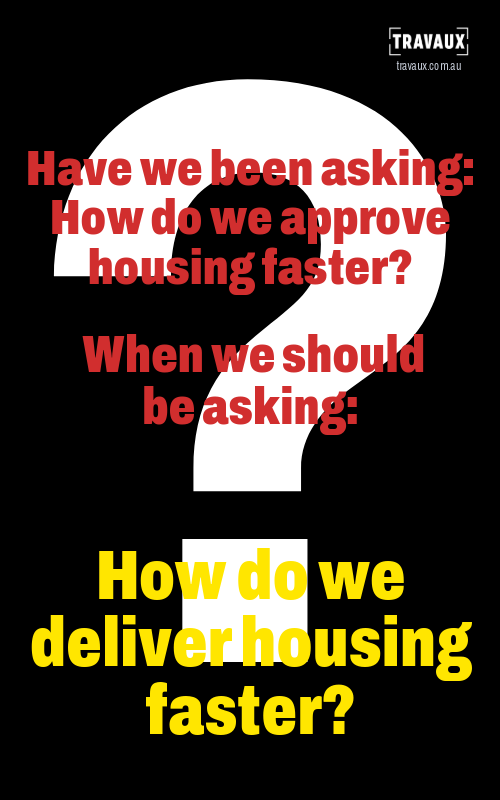
Perhaps we’ve – and by we, I mean the Australian government – been asking:
“How do we approve housing faster?”
When the real question should be:
“How do we deliver housing faster?”
Those are not identical questions.
The first improves a process.
The second improves the outcome.
Measuring What Matters
Governments increasingly celebrate housing approvals.
Developers celebrate planning permits.
Industry celebrates reforms.
But none of these things house a family. Completed homes do.
If Australia’s housing crisis is fundamentally a delivery problem – as I increasingly suspect- then our policies should be judged on the speed and reliability of the entire delivery chain, not simply one link within it.
Planning matters.
But it may not matter in the way we’ve assumed.
The next stage of this research will attempt to answer exactly that question.
Because before we prescribe solutions, we should first be certain we’ve correctly diagnosed the problem.