We use cookies to optimize your experience, analyze traffic, and personalize ads. Please choose whether you accept our use of non-essential cookies. Read More

Australia does not deliver housing simply by creating more theoretical capacity.
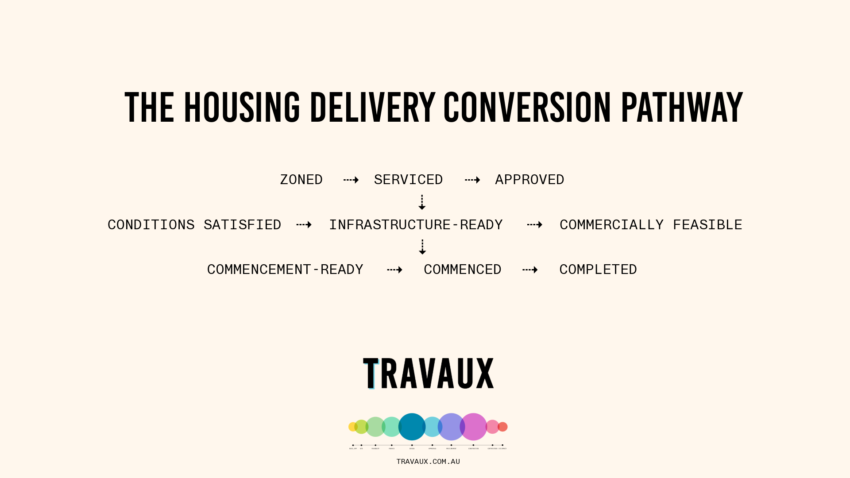
Land can be zoned, serviced and approved without becoming a completed home. Commercial feasibility, infrastructure, regulatory conditions, finance, construction capacity and other factors all influence whether a project continues through to delivery.
Our submission to the Productivity Commission argues that housing reform should therefore be understood through conversion: whether additional capacity moves from zoning and approval into commencement and completion, and where that conversion breaks down.
01. MEASURE CONVERSION, NOT JUST CAPACITY
Zoning and approvals tell us how much housing could potentially be delivered. They do not tell us how much progresses to construction.
Reporting should extend beyond zoned and approved capacity to observe conversion through commencement and completion. This would provide a clearer measure of whether reforms are producing real housing outcomes rather than additional housing on paper.
02. MAKE THE INTERFACES VISIBLE
Housing projects pass between councils, referral authorities, infrastructure providers and other decision-makers.
Problems can occur not because an individual requirement is unreasonable, but because of the interface between requirements — their sequence, information needs, ownership and conflict-resolution arrangements.
The submission proposes making these dependencies explicit: what must happen first, what information is required, who owns the next decision, who can resolve conflicts and what becomes blocked when a decision is delayed.
03. MEASURE END-TO-END TIME
Faster individual approvals do not necessarily mean faster housing delivery.
A project can pass quickly through one approval and then wait months for a referral, utility decision, subdivision condition or post-approval requirement.
Alongside individual processing times, governments should examine the total elapsed time across the regulatory pathway required before construction can begin.
04. GIVE COORDINATION REAL AUTHORITY
Coordination is most useful when somebody has the authority to resolve competing requirements.
Simply identifying who is responsible may also be insufficient. The responsible organisation needs the authority, funding and operational capacity to perform its role when the delivery pathway requires it.
05. TEST THE SYSTEM AGAINST INDUSTRIALISED CONSTRUCTION
Modern Methods of Construction do not simply substitute one building technology for another. Industrialised construction can change the sequence of project delivery.
Its programme advantage can depend on earlier design certainty and factory manufacture occurring in parallel with site preparation and infrastructure works. Approval systems designed around conventional sequential construction can therefore remove some of the productivity benefit MMC is intended to provide.