


Australia is betting heavily on Build-to-Rent. But before we ask whether it works in regional Australia where demand is high, we need to understand how the model actually makes money.
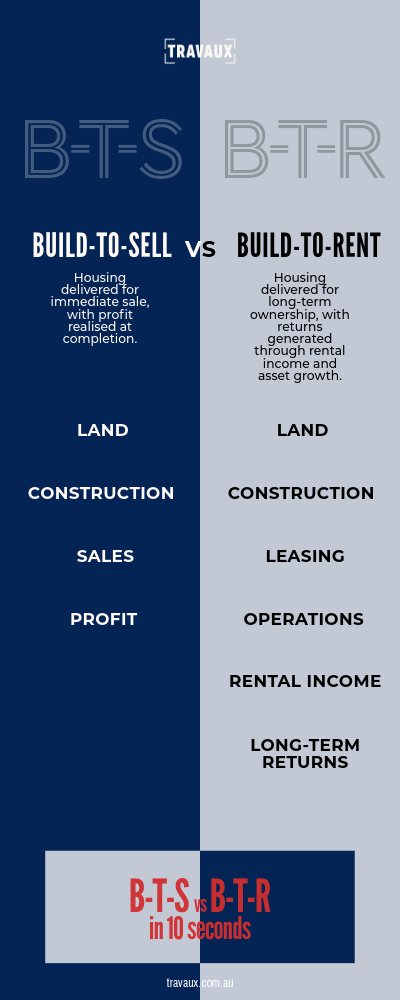
Most Australians are familiar with the traditional development model:
- Buy land
- Build homes
- Sell homes
- Repay debt
- Make profit
Build-to-Rent turns that model upside down.
Instead of selling the apartments, the developer or investor keeps them.
The project becomes a long-term income-producing asset rather than a one-off development.
That sounds simple enough.
The challenge is that keeping the apartments means giving up the immediate sales revenue that traditionally funds a development.
That’s where feasibility becomes much more complicated.
What is Build-to-Rent?
A Build-to-Rent project is purpose-built housing designed to remain under single ownership and be professionally managed as a long-term rental community. Rather than selling apartments individually, the owner retains the asset and earns income through rent.
Typically these projects are backed by:
- Superannuation funds
- Pension funds
- Institutional investors
- Property investment platforms
- Sovereign wealth funds
Unlike a traditional apartment project, success is measured by:
- Occupancy
- Rental income
- Tenant retention
- Asset value growth
- Operational performance
rather than apartment sales.
Why Investors Like It
Most property developers make money once.
BtR investors want to make money repeatedly.
A completed apartment tower producing rent every month can create stable cash flow over decades.
That’s particularly attractive to institutions managing retirement savings and long-term investment portfolios.
Think of it this way:
A developer wants:
Development profit.
An institutional investor wants:
Long-term income.
Different objectives create completely different feasibility models.
The Feasibility Problem Nobody Talks About
This is where the article gets interesting.
A traditional apartment developer can sell 150 apartments immediately after completion.
That sales revenue repays debt and generates profit.
A BtR developer cannot.
Instead, they must:
- Fund the land
- Fund the construction
- Carry interest costs
- Lease the building
- Stabilise occupancy
before the project reaches its intended value.
This creates a much heavier capital burden. Banks typically assess lending against lower pre-stabilised valuations rather than fully leased values, requiring significantly more equity upfront.
In plain English:
BtR often needs deeper pockets.
If Build-to-Rent is So Good, Why Isn't Everyone Doing it?
On paper, Build-to-Rent sounds attractive.
It can create long-term rental housing, provide stable income for investors and increase housing supply without relying on individual apartment sales.
So why hasn’t Australia seen thousands of Build-to-Rent projects emerge overnight?
The answer is feasibility.
Unlike a traditional apartment project, a Build-to-Rent developer doesn’t receive a large cash injection from apartment sales at completion. Instead, the project must generate enough rental income over time to justify the land cost, construction cost, finance costs and ongoing operational expenses.
That challenge becomes even more pronounced outside Australia’s major capital cities.
Want to understand whether a development stacks up before spending thousands on consultants?
Travaux Build-Ready Reports help developers, investors and project teams assess planning constraints, feasibility risks and delivery considerations before committing to a site.
Why Regional Australia Changes the Equation
The same financial model that may work in Sydney, Melbourne or Brisbane doesn’t automatically work in Ballarat, Bendigo, Geelong, Newcastle or Cairns.
Land may be cheaper, but construction costs often aren’t.
At the same time:
- Rental markets are smaller
- Investor demand can be weaker
- Exit opportunities are more limited
- Long-term rental growth may be less certain
In simple terms:
Lower land costs don’t always offset lower rental returns.
This is why many industry experts argue that regional Build-to-Rent projects require a different approach rather than simply copying metropolitan models.
The Regional Feasibility Equation
BDO Australia explored a number of different points in their article ‘Build-to-Rent (BtR) in the Regions’ that will affect how the model can work in regional Australia. There are three main points that need to be resolved for BtR to work outside of the major metropolitan areas.

1. Smaller Projects
BDO suggests regional projects may need to operate at around 100-150 apartments rather than the larger metropolitan formats.
Smaller projects reduce capital exposure.

2. Different Capital Structures
Institutional investors may need portfolio approaches rather than treating each regional project as a standalone investment.
Think:
- Five regional projects
rather than - One giant regional project

3. Strong Demand Drivers
Not every regional town is suitable.
The strongest candidates tend to have:
- Population growth
- Employment growth
- Education sectors
- Health sectors
- Infrastructure investment
BDO specifically highlights centres such as Geelong, Newcastle, Cairns and Mackay as examples where these characteristics may exist.
The Bigger Lesson
Whether you support BtR or not is almost beside the point.
The real lesson is understanding how housing gets delivered.
Many housing debates focus on:
- Planning approvals
- Density
- Design
- Construction methods
But BtR reveals a deeper reality.
If the numbers don’t stack up:
Nothing gets built.
This is why housing delivery is ultimately a feasibility challenge.
Planning matters.
Construction matters.
Finance matters.
Operations matter.
The successful delivery of housing occurs when all of those pieces align.
Wrapping things up
Build-to-Rent isn’t simply another housing product.
It’s a different financial model.
And that’s exactly why it’s useful to study.
The debate about whether BtR should expand into regional Australia is really a debate about project feasibility, capital allocation and housing delivery.
Understanding that helps explain a much broader truth:
Housing shortages are rarely caused by a lack of ideas.
They’re usually caused by a lack of feasible projects.
Understanding Housing Starts with Understanding Feasibility
Many housing debates focus on planning approvals, density targets and construction methods.
Far fewer explore the financial realities that determine whether projects proceed at all.
Permit Pending examines the planning, property and construction decisions shaping Australia’s housing future — one project, policy and feasibility challenge at a time.
Subscribe for weekly analysis on housing delivery, development feasibility and the decisions influencing what gets built — and what doesn’t.
FAQs
Build-to-Rent (BtR) is a residential development model where apartments or homes are built specifically for long-term rental rather than individual sale. The entire development remains under single ownership and is professionally managed.
Build-to-Rent projects generate income through ongoing rental payments rather than apartment sales. Investors rely on rental income, occupancy rates and long-term asset growth to achieve returns.
Build-to-Rent is attracting interest because it can provide professionally managed rental housing, improve housing supply and offer institutional investors long-term income streams that align with superannuation and pension fund investment strategies.
No. Traditional apartment developments are typically built to sell individual dwellings. Build-to-Rent projects are designed to remain under one owner who earns income from rent rather than sales.
Build-to-Rent projects require significant upfront capital because developers cannot rely on apartment sales to recover costs immediately after construction. Project feasibility depends on rental income, financing costs and long-term operational performance.
Potentially, but regional Build-to-Rent projects often face different financial challenges. While land may be cheaper, rental returns can also be lower, meaning the traditional metropolitan Build-to-Rent model may require adaptation to remain feasible.
Build-to-Rent can contribute to housing supply, but it is not a standalone solution. Housing delivery depends on planning, infrastructure, finance, construction capacity and project feasibility working together.