


Home » Dispatches » why-prefabrication-costs-more-than-expected
- Reading time: approx. 8 minutes
- No Comments
We tend to evaluate construction methods by examining how efficiently they produce and assemble buildings. But a building is also the outcome of a much larger development process, involving decisions, information, approvals, finance, procurement, contracts, responsibilities and risk.
Each of those processes interacts with the others. Changing the construction method changes those interactions, sometimes significantly.
Which raises another question.
What if improving construction productivity requires us to examine not just how we build, but how we organise the entire process of getting a project built?
The debate about prefabrication costs reveals a bigger question about how we plan, design, procure and deliver construction projects...
A recent LinkedIn article by Canadian architect, urban designer and writer, Misha Bereznyak, ‘Why has prefabrication failed to reduce construction costs — or even manage to compete with on-site construction on price?’ prompted a fascinating discussion among architects, developers, manufacturers and construction practitioners.
Misha raises a legitimate question. If manufacturing has transformed productivity and reduced costs across so many industries, why hasn’t prefabrication consistently delivered the same results in construction?
The article itself is worth reading, but so are the comments. Together, they reveal something interesting: people with experience in different parts of construction are identifying different reasons why the anticipated savings haven’t materialised.
And many of them are right.
Perhaps the problem is that we’re still examining individual parts of a much bigger process.
Read the original article here: LinkedIn Article, Why has prefabrication failed to reduce construction costs — or even manage to compete with on-site construction on price?
The Economics Can't Be Ignored.
Misha’s article draws on Brian Potter’s The Origins of Efficiency to examine why construction has not achieved the productivity gains experienced in other manufacturing industries.
He makes several important observations:
- Many construction materials and components are already manufactured efficiently. Prefabrication doesn’t start from a position where every building element is made by hand.
- Buildings are also large, difficult and expensive to transport. Factories need sufficient production volume to justify investment, yet construction demand is geographically dispersed, project-specific and cyclical.
- Moving more work into a factory can introduce additional costs associated with facilities, equipment, transport, handling and installation. These are legitimate constraints. We shouldn’t dismiss them simply because industrialised construction has considerable potential.
But they also raise a question: are we examining the economics of the manufacturing activity, or the economics of delivering the entire project? Those aren’t necessarily the same thing.
Are we examining the economics of the manufacturing activity or the economics of delivering the entire project?
The Work Doesn't Disappear. It Moves Upstream.
One of the particularly useful contributions to Misha’s discussion came from Damian Hadley of Cantilever.
Damian highlighted the substantial amount of work that happens before a prefabricated or modular building arrives on site.
A building assembled in two days may represent months of design resolution, coordination, planning, preparation and decisions that had to occur before manufacturing and installation could begin.
I’ve followed Cantilever’s work with interest over the years, and this observation captures something important about industrialised construction – a shorter installation period doesn’t mean all the other work has disappeared.
Some work has moved earlier.
Some requires greater precision.
Some tasks that could previously be resolved progressively on site now need to be completed before manufacturing starts.
There can be considerable benefits in doing that work earlier, including better coordination, fewer site variations, improved quality and more predictable construction.
But it is still work. And unless we examine where it occurs, who performs it, what it costs and how it affects the project overall, we risk making comparisons that don’t capture the full picture.
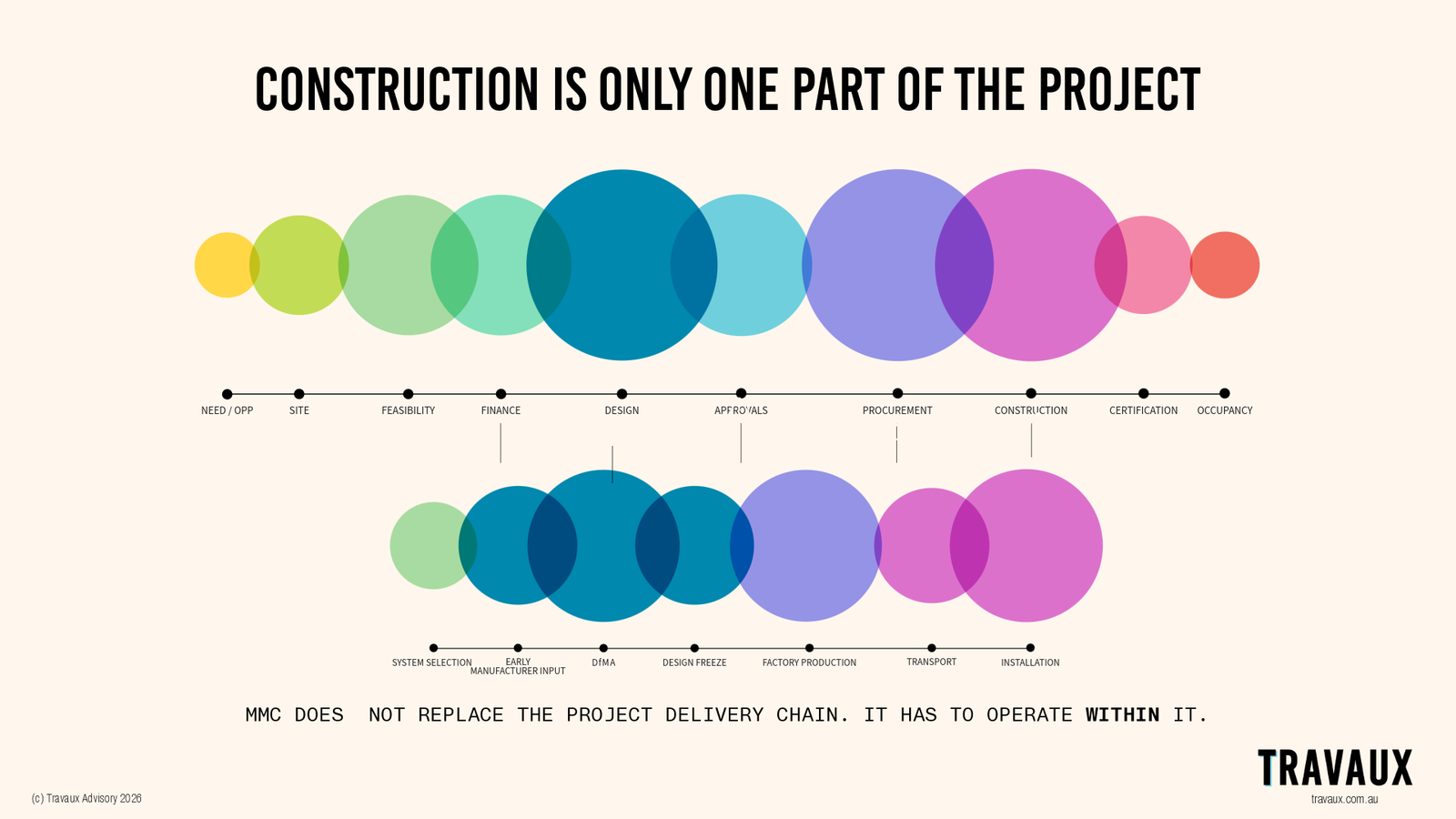
Are We Even Comparing the Same Thing?
A conventional construction estimate and a prefabricated construction estimate may not necessarily represent the same scope, information maturity or allocation of risk.
One may allow for decisions, coordination and adjustments to occur during construction. The other may require much of that information to be resolved before production.
The manufacturer may also be assuming responsibility for activities, coordination or performance requirements that sit elsewhere in a conventional project.
Consequently, a comparison based principally on construction price per square metre can conceal important differences.
That doesn’t mean prefabrication is necessarily cheaper once everything is considered. Sometimes it won’t be.
But an informed comparison needs to examine the same scope and the consequences for the whole project.
Those consequences may include design and consultant costs, financing, procurement, programme certainty, site establishment, construction duration, defects, risk and the timing of occupation or revenue.
A higher construction price could still produce a better overall development outcome. Equally, a shorter construction programme might provide little benefit if delays elsewhere prevent the project progressing.
We need to test the project, not simply compare the construction products.
A higher construction price could still produce a better overall development outcome and equally, a shorter construction programme might provide little benefit if delays elsewhere prevent the project progressing.
It's What Happens Between the Parts
This is where I think the discussion needs to expand.
Construction doesn’t begin when work starts on site or when a manufacturer starts production.
Long before either occurs, a developer has made decisions about the land, project feasibility, intended market, design, approvals, procurement, finance, construction arrangements and delivery programme.
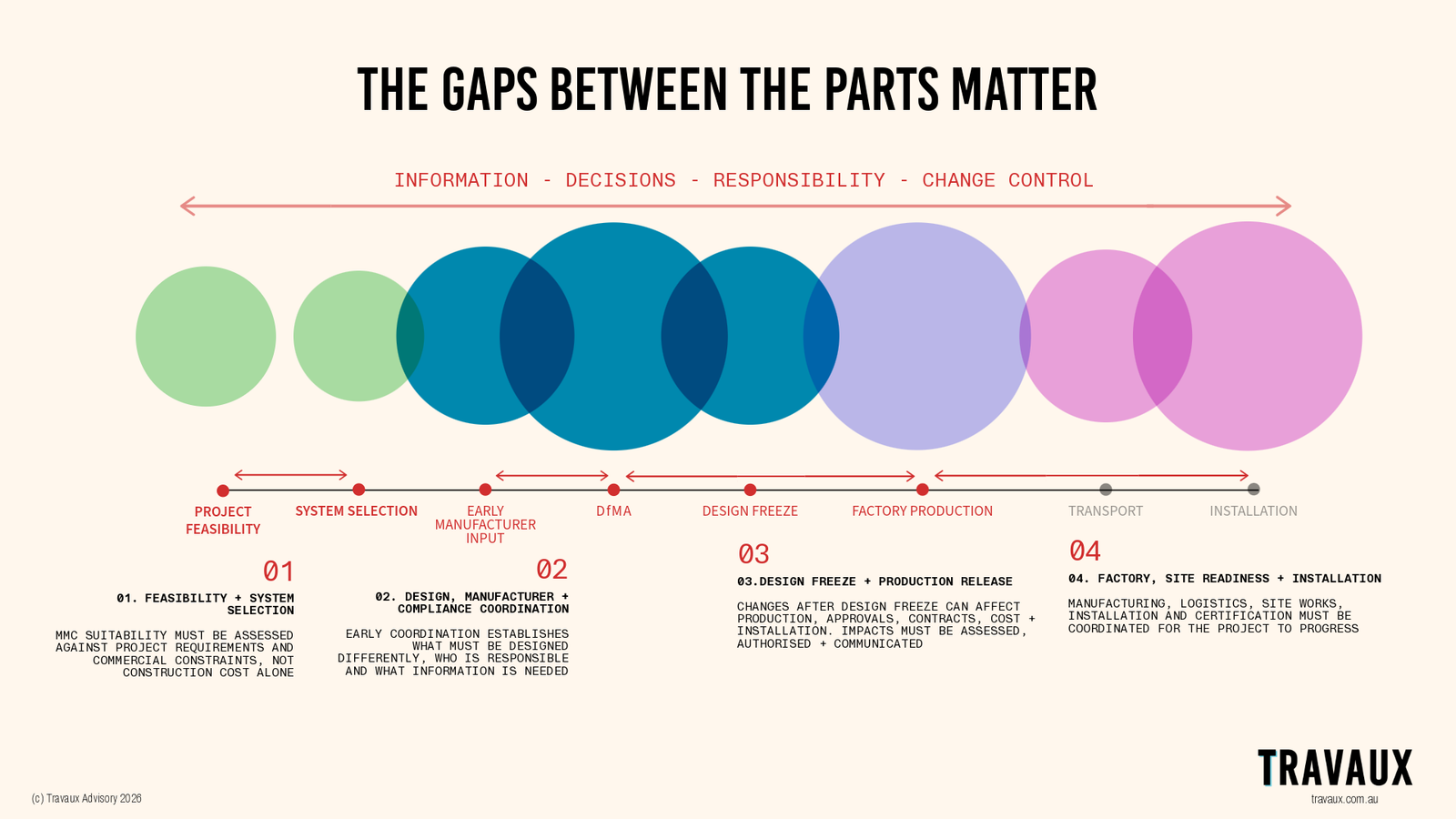
Each decision creates information, responsibilities and dependencies for the next part of the process. And there are interfaces between them.
Between development feasibility and design.
Between design and engineering.
Between design documentation and manufacturing requirements.
Between approvals and the actual construction system proposed.
Between procurement, contracts and project finance.
Between manufacturing, transport, site readiness and installation.
And between everyone responsible for coordinating those activities.
These interfaces exist in conventional construction too. But industrialised construction can make their weaknesses more visible because decisions and information often need to be resolved earlier.
Where those interfaces aren’t properly managed, the supposed efficiencies of prefabrication can be lost before manufacturing even begins.
That isn’t necessarily a failure of the factory.
It may be a failure to organise the project around the production system being used.
You Can't Bolt MMC Onto a Project
Choosing a construction method isn’t the same as integrating it.
A developer might arrive at a relatively advanced design and then investigate whether prefabrication could make the project faster or cheaper.
By that stage, significant decisions may already have been made.
The structural arrangement, building dimensions, planning conditions, service locations, contractual responsibilities or financing assumptions may not suit the proposed manufacturing system. Changing the construction method late can introduce redesign, additional approvals work, duplicated effort and new commercial risks.
Rather than providing an advantage, prefabrication becomes something the project must accommodate retrospectively.
This is why I think we need to distinguish between selecting a construction product and integrating a construction system into a development project.
The opportunity is not necessarily to use MMC on every project.
It is to establish early enough whether conventional construction, industrialised construction or a combination offers the most appropriate delivery approach, and what needs to change for that approach to work.
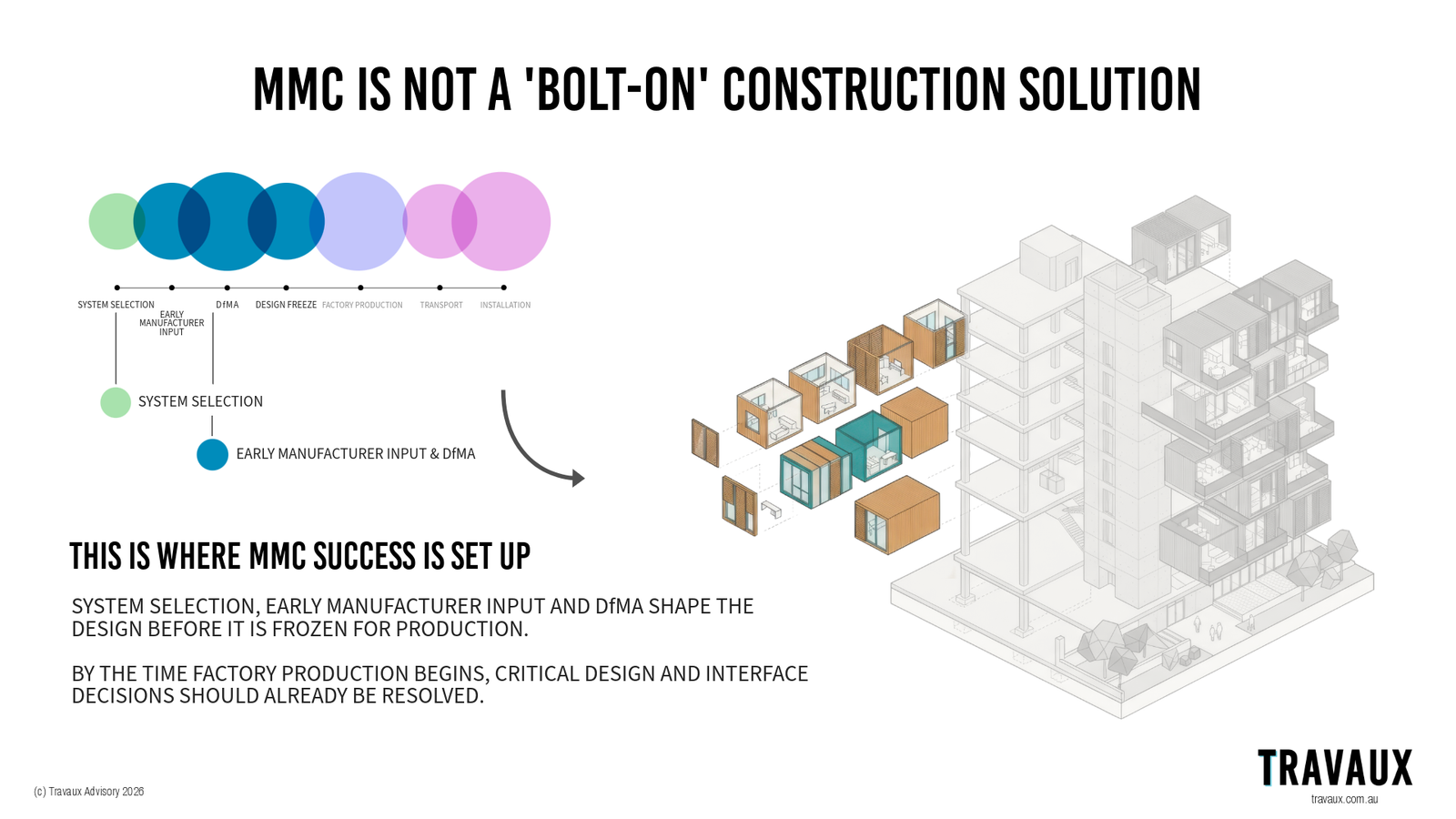
We need to distinguish between selecting a construction product and integrating a construction system into a development project.
Faster Construction. But Faster Delivery?
Much of the public discussion about MMC centres on construction speed and cost. Both matter enormously.
But faster manufacturing or installation does not automatically mean faster housing delivery.
Nor does a lower factory production cost necessarily mean a lower overall development cost.
A project still has to become commercially feasible, obtain approvals, secure finance, complete its design and procurement, prepare its site, coordinate its participants and reach completion.
The performance of one activity only tells us part of the story.
Perhaps we should be asking how well those activities work together.
Where are decisions being made too late?
Where is information being duplicated, delayed or transferred without clear responsibility?
Where do contracts, finance and procurement fail to align with the proposed construction method?
Which activities genuinely become faster, and which simply move earlier?
And how do we assess those changes against the overall project outcome?
These are not exclusively MMC questions. They’re construction delivery questions.
The Whole Project is the Opportunity
I don’t think we need to choose between the arguments that prefabrication has structural cost disadvantages, that manufacturers need greater volume, or that developers and project teams need to approach projects differently.
All may be true.
The difficulty is understanding how they interact.
Production volume matters, but so does having projects designed and procured in ways that support repeatability.
Early design coordination matters, but so does having clear contractual responsibility for the decisions and information required.
Shorter installation programmes matter, but only where site readiness, logistics and the broader development programme allow those savings to be realised.
And cost competitiveness matters, but it needs to be measured against equivalent project outcomes.
Industrialised construction may offer significant opportunities to improve housing delivery. However, those benefits aren’t automatic, universal or confined to the factory.
The challenge is to understand the project as a connected development and delivery process, identify where conventional and industrialised approaches differ, and manage the interfaces accordingly.
Perhaps the next productivity gain won’t come from improving one more part of construction in isolation, but from improving how all the parts work together.
The challenge is to understand the project as a connected development and delivery process, identify where conventional and industrialised approaches differ, and manage the interfaces accordingly.
This article was prompted by Misha Bereznyak’s discussion of prefabrication costs and the contributions from practitioners responding to it, including Damian Hadley’s observations about the substantial work undertaken before offsite installation.
Read the original article and industry discussion: Why has prefabrication failed to reduce construction costs? — Misha Bereznyak, 8 October 2026
Travaux Advisory works across development strategy, housing delivery and the integration of modern methods of construction, with a focus on how project information, decisions and delivery responsibilities interact.